When Heat Changes How We Feel
This is no longer only an anecdote. A new global study, co-authored by Juan Palacios together with researchers from MIT and partner institutions, shows that very hot days are associated with more negative sentiment around the world.
The study uses a simple idea at an enormous scale: when people experience different weather conditions, does the emotional tone of what they write online change?
The answer is yes. Once temperatures rise above 35°C, people’s expressed sentiment becomes significantly more negative — especially in places with fewer resources to adapt.
A global thermometer for human mood
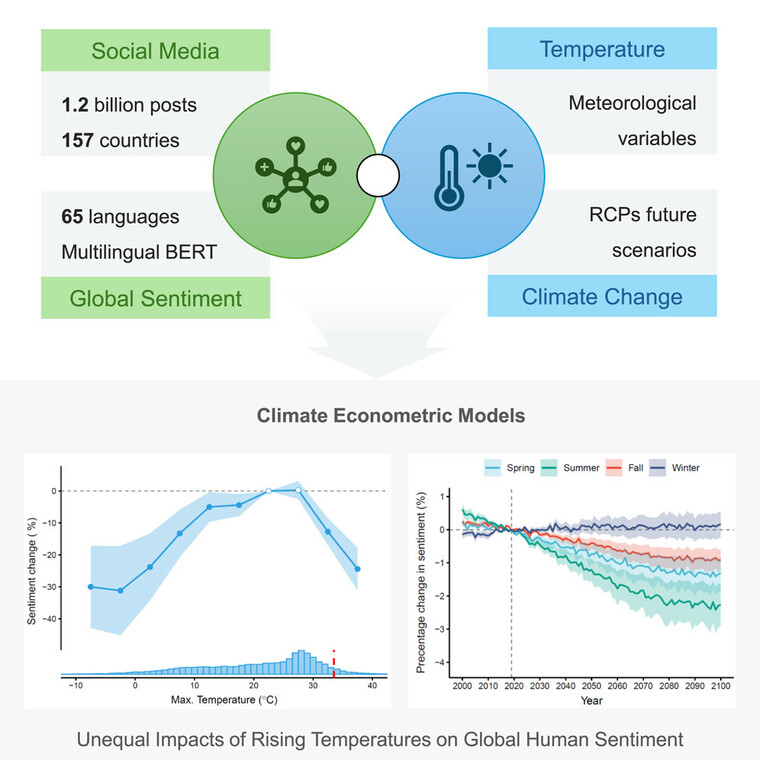
The researchers analyzed more than 1.2 billion geotagged social media posts from 157 countries. The posts came from Twitter and Weibo and covered 65 languages. Using natural language processing, the team assigned each post a sentiment score from very negative to very positive, then linked those scores to local daily weather conditions.
The approach provides a new window into how heat is experienced in daily life. Traditional surveys are valuable, but they are expensive and usually limited in time and geography. Social media data are not perfect — not everyone uses social media, and users are not fully representative of the population — but they allow researchers to observe emotional expression across countries, climates, and income levels at a scale that was previously difficult to achieve.
-
1.2 billion social media posts analyzed across the world157 countries included in the global analysis
The study finds an inverse-U relationship between temperature and sentiment. Around moderate temperatures, sentiment is highest. Globally, this comfortable range is around 20°C to 25°C. But above that range, sentiment begins to fall. At daily maximum temperatures between 35°C and 40°C, global sentiment declines by 0.244 standard deviations compared with the comfortable temperature range — equivalent to a 24.4% decline in expressed sentiment.
To make this more intuitive: the paper shows that the negative sentiment effect of extreme heat is larger than the average difference in sentiment between weekdays and weekends. In other words, very hot days leave a clear emotional footprint.
The burden of heat is unequal
One of the most striking findings is that the impact of heat differs sharply across income levels. In low- and middle-income countries, temperatures above 35°C are associated with a 25.0% decline in sentiment. In high-income countries, the decline is 8.1%.
This threefold difference points to the role of adaptation. Wealthier households, firms, and cities are more likely to have access to cooling, better-insulated buildings, shaded public space, and health systems that can respond during heatwaves. More vulnerable households and communities often have fewer options, even though they may face the greatest exposure.
For the real estate sector, this is a crucial message. Climate inequality is not only about who faces higher flood risk or who pays more for energy. It is also about who can remain comfortable, productive, and emotionally well during increasingly hot summers.
Why this matters for real estate
Real estate is central to the heat problem because buildings and neighbourhoods shape exposure. The same outdoor temperature can feel very different depending on the apartment, office, school, or street where people spend their day. Shading, ventilation, insulation, building orientation, materials, windows, access to cooling, and the presence of trees or water all influence whether heat becomes manageable or unbearable.
Three lessons for the built environment
First, indoor heat should be measured. Energy labels and carbon metrics are important, but they do not always tell us whether a dwelling or workplace remains liveable during a heatwave.
Second, adaptation should start with vulnerable occupants. Elderly residents, low-income households, social housing tenants, students, and people in dense urban areas may have fewer ways to avoid overheating.
Third, cooling should be designed carefully. Passive cooling, shading, green infrastructure, ventilation, and urban design can reduce heat stress while avoiding a simple shift toward higher energy demand from air conditioning.
From energy efficiency to summer resilience
In the Netherlands and other traditionally temperate countries, much of the building stock was designed with winter in mind. Insulation, airtightness, and energy efficiency remain essential for reducing emissions and lowering energy bills. But hotter summers add a second challenge: buildings must also protect occupants from overheating.
This means that renovation strategies need to look beyond winter energy performance. A building can be efficient in January and uncomfortable in July. Housing associations, investors, developers, and municipalities will increasingly need to ask: does this building remain healthy and liveable during extreme heat?
A broader view of climate adaptation
By 2100, the study projects that global average sentiment could be 2.3% lower than in 2019 because of warming, even after accounting for some adaptation. This number is an average, and averages hide inequality. In cooler places, some warming may improve comfort in winter. In hotter and more vulnerable places, summer impacts may be much more severe.
The message for real estate is clear. Climate adaptation should not be evaluated only by avoided physical damage or financial losses. It should also be evaluated by how well it protects everyday life: sleep, comfort, mental well-being, productivity, learning, and social interaction.
As summers become hotter, heat-resilient real estate will be not only more sustainable, but also more humane.
Read the full paper
Wang, J., Guetta-Jeanrenaud, N., Palacios, J., Fan, Y., Kakkar, D., Obradovich, N., & Zheng, S. (2025). Unequal impacts of rising temperatures on global human sentiment. One Earth, 8, 101422.
https://doi.org/10.1016/j.oneear.2025.101422
Further reading: MIT News, “Study links rising temperatures and declining moods,” August 21, 2025 .